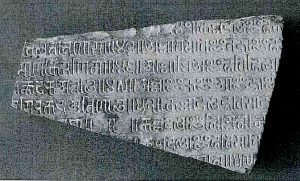
Dhār (Madhya Pradesh). Fragment of a Prakrit poem recording the defeat of Karnāṭaka. (Courtesy ZENODO).
Working copy based on transcription prepared by Andrew Ollett (2025)
Analysis of surviving verse fragments
Verse 41:[1]
kannaḍa | ü i ha [*ku?? – – – – – – – ||]
[* – – – – – – – – – – – – – – – – – – ||]
[* – – – – – – – – – – – – ||]
[* – – – – – – – – – – – – – – – || *41 |]|
Possible Sanskrit chāyā: karṇāṭe ‘py iha… The target of the campaign in named: “Even here in Karṇāṭa…” Only part of the next letter after ‘ka’ is visible. A possible restoration is kuṁtala which fits the metrical requirements but this remains hypothetical until further parts of the record are recovered.
Verses 42:
This verse is missing.
Verse 43:
[* – – – – – – – – – – – – ||]
[* – – – – – – – – – – – – – – – – – – ||]
[* – – – – – – – – – – – – ||]
[* – – – – – – -] va | üttā | ta | ē ē | sā || 43 ||[2]
Possible Sanskrit chāyā: … upayuktā tvayā eṣā. Here the poem turns to the king (taē, tvayā), establishing his agency with regard to ‘she’—evidently the enemy queen or, more likely, the goddess of fortune who is supporting his campaign, thus “she [Victory/Fortune] was enjoyed by you…”
Verse 44:
annā | paya ti i | aṁ jā [read: ja] | i ha [* – – – – ||]
[* – – – – – – – – – – – – – – – – – – ||]
[* – – – – – – – – – – – – ||]
[* – – – – – – – – – – – – – – – || *44 ||]
Possible Sanskrit chāyā: anyat padaṃ tṛtīyaṃ yā iha … or ājñā-padaṃ tṛtīyaṃ yā iha …
The gist here is “She [the Goddess of Victory/Fortune], who [has taken] a third step here [in Karṇāṭa].” This gloss suggest that the march toward the south was the third step in a campaign of universal conquest. Somewhat adenturously, we could add mahīsava (“the whole earth”), following iha, thus: annā | paya ti i | aṁ ja | i ha [*ma | hī sa | va – – | – – – – | – – ||]
Verse 45: This verse is missing.
Verse 46:
[* – – – – – – – – – – – – ||]
[* – – – – – – – – – – – – – – – – – – ||]
[* – – – – – – – – – – – – ||]
[* – – – – – – – – -] sā | ṇa | kiṁ bhaṇi | mō || 46 ||[3]
Possible Sanskrit chāyā: … [tā]sāṃ kiṃ bhaṇāmaḥ. Here the poet uses a rhetorical device, claiming the impact of the war is so great that language fails: kiṁ bhaṇimō, “what can we say?” of them, or to them, (tāsāṃ), genitive plural feminine, so possibly the women of Karṇāṭa, given what follows, or more abstractly, three dimensions of the conquest, kīrti (fame), lakṣmī (fortune), dhṛti (resolve, fortitude), an idea that carries into the following verse.
Verse 47:
annō | ccia ïha | tihichā [* – – – – ||]
[* – – – – – – – – – – – – – – – – – – ||]
[* – – – – – – – – – – – – ||]
[* – – – – – – – – – – – – – – – || *47 ||]
Possible Sanskrit chāyā: anyaḥ caiva iha trividhā…The gist is difficult to determine with certainty. Literally this can be glossed “Different here indeed is the three-fold…” The word trividhā suggests a triad of features centring on the king’s military triumph or the king himself, the point being that the campaign stands out as exceptional. In the Pārijātamañjarī, Arjunavarman is described as Trividhavīracūḍāmaṇi (The Crest-Jewel of the Three-fold Hero), and portions of this title are used with reference to the king in other :records: thus Trividhavīra is mentioned in his copper-plate grants and Vīracūḍāmaṃi is found in his commentary on the Amarūśataka, the Rasikasañjīvani.[4]
Verse 48:
This verse is missing, but it seems that this would have taken us from the three-fold qualities of the king and conquest to specifics about the war. This is elaborated in verse 49.
Verse 49:
[* – – – – – – – – – – – – ||]
[* – – – – – – – – – – – – – – – – – – ||]
[* – – – – – – – – – – – – ||]
[* – – – – – -] [*pā u?]k | kaṁ ṭhaṁ | ru | an tī | ō || 49 ||[5]
Possible Sanskrit chāyā: … [prā?] utkaṇṭham rudantyaḥ. This refers to the queens not only weeping (rudantyaḥ/ruantīō) but turning their necks in anxious longing; one might imagine their scanning the battlefield for the corpses of their dead husbands.
Verse 50:
annā | iṁ ru ï | ā iṁ[*a] | jā i [*a – – – ||]
[* – – – – – – – – – – – – – – – – – – ||]
[* – – – – – – – – – – – – ||]
[* – – – – – – – – – – – – – – – || *50 ||]
Working with the restoration annāiṁ ruïāiṁa jāi [aṁti], a possible Sanskrit chāyā is anyāni ruditāni yāni [or yānti]. With this verse the description of the carnage is amplified by the weeping that arises from others, either queens or the wives of dead warriors.
Verse 51:
This verse is missing, but the annihilation of the southern army is a likely theme, this leading to verse 52.
Verse 52:
[* – – – – – – – – – – – – ||]
[* – – – – – – – – – – – – – – – – – – ||]
[* – – – – – – – – – – – – ||]
[* – – – – – – – -] | si ra kaṁ | du | a vi ṇō | ō || 52 ||[6]
Possible Sanskrit chāyā: … śiraḥ kandukavinodaḥ. The narrative shifts from the women to a grusome battle scene with the king treating the severed heads of his enemies like balls in a game.
Verse 53:
kannā | ḍa ō ha | vē sā | [jā?] [*sav va | ka lā – – ||]
[* – – – – – – – – – – – – – – – – – – ||]
[* – – – – – – – – – – – – ||]
[* – – – – – – – – – – – – – – – ||*53 ||]
Posssible Sanskrit chāyā: karnāṭakaḥ … have sā … which would suggest the royal fortune of Karṇāṭa stands humilated in the “sacrifice of battle” (have). However, given ‘ja’ is fairly certain and taking the reading to be ‘jā’, we can supply the name Sarvakalā, the name of Arjunavarman’s wife from Kuntala, as documented by the Pārijātamañjarī inscription.[7] In Prakrit this is Savvakalā which fits the metrical structure. Following the queue of the Pārijātamañjarī in which the heroine Pārijātamañjarī is the personification of the royal glory of Jayasiṃha, the Cālukya ruler of Gujarat defeated by Arjunavarman, we can understand this as a reference to the Karṇāṭa queen as Arjunavarman’s trophy, the sense being that “Indeed, she whose attire (or appearance) is that of Karṇāṭa, Sarvakalā, (was taken as his victory prize).” Given that the Sanskrit chāyā for vēsā can be veśyā, a more compelling gloss would be: “Indeed, the courtesan of Karṇāṭa, Sarvakalā, (was taken as his victory prize).” That the ideal courtesan is a ‘mistress of the arts’ supports this interpretation.[8] Like a courtesan, the Glory of Sovereignty (rājyalakṣmī) is a fickle mistress, ready to change her allegiance according to circumstance.
*Verse 54:
[*kannaḍa | ō – – – – – – – – – – ||]
[* – – – – – – – – – – – – – – – – – – ||]
[* – – – – – – – – – – – – ||]
[* – – – – – – – – – – – -] | pā? || || ||
This verse is not preserved except for the last mātrā. The verse number is not given, but multiple daṇḍa marks and the skipping of numbers are conventions found in manuscripts. There seems to be no thematic break given the opening kannaḍa | ō is repeated several times before and after this verse. A repeated use of “kannaḍa | ō” in drumbeat fashion would befit a dramatic recitation. The shift might be geographical with the verses below describing the queen ‘here’ in Dhār, Arjunavarman’s capital and, of course, the place where the inscription under study was found. With verse numbers shown, we are on firm ground reconstructing the missing numbers given the space that would have been occupied by each Āryā verse.
Verse 55:
kannaḍa | ō ili | sēlā | [*nnā? – – – – – – ||]
[* – – – – – – – – – – – – – – – – – – ||]
[* – – – – – – – – – – – – ||]
[* – – – – – – – – – – – – – – – || *55 ||]
Possible Sanskrit chāyā: … śailānyā for sēlā-nnā. The final letter appears to be ‘nn’ without any trace of the vowel visible. If the reconstruction is accepted, this apparently means: “Here (in Dhār, Arjunavarman’s capital), the [Queen] of Karṇāṭa, the mountain born…,” evidently a description of Sarvakalā as Pārvatī. We could surmise this shows her elevation in status after she arrived in the capital.
Verse 56:
kannaḍa | ō i ha | vē sā | tē [* – – – – – – – ||]
[* – – – – – – – – – – – – – – – – – – ||]
[* – – – – – – – – – – – – ||]
[* – – – – – – – – – – – – – – – || *56 ||]
This continues the description of the queen in Dhār. Rather adventurously, we could restore this as follows: kannaḍa | ō i ha | vē sā | tē [rā aṁ | ti hu | va ṇē | rē ||]; Sanskrit chāyā: karṇāṭō ‘tra veṣā | tē rājantē bhuvanē rē ||, the sense being: “The guises of the [Queen] of Karṇāṭa shine here in the palace!” In our view, because Prakrit vēsā can be glossed as both veṣāor veśyā, the poet has shifted the meaning to make Sarvakalā the southern ornament of the Paramāra court.
Verse 57:
[*?kannaḍa | ō – – – – – – – – – – ||]
[* – – – – – – – – – – – – – – – – – – ||]
[* – – – – – – – – – – – – ||]
[* – – – – – – – – – – – – – – – ||] *57 ||
Verse 58:
[*?kannaḍa | ō – – – – – – – – – – ||]
[* – – – – – – – – – – – – – – – – – – ||]
[* – – – – – – – – – – – – ||]
[* – – – – – – – – – – – – – – – ||] *58 ||
These two verses are missing entirely. They may have continued the ‘drumbeat’ of kannaḍa | ō.
Verse 59:
[*?kannaḍa | ō – – – – – – – – – – ||]
[* – – – – – – – – – – – – – – – – – – ||]
[* – – – – – – – – – – – – ||]
[* – – – – – – – – – – -] lē || 59 ||
[1] Conventions used: each dash (-) represents one mātrā (pāda 1: 12 mātrā, pāda 2: 18 mātrā, pāda 3: 12 mātrā, pāda 4: 15 mātrā). Vertical bars or daṇḍa (|) mark word boundaries in preserved text. [*…] indicates restored/lost text. [*?…] indicates uncertain restoration.
[2] The final –ā can sometimes be treated as metrically light despite being phonologically long, especially at verse-end, this being called termed padānta laghu.
[3] Again the final vowel treated as metrically light despite being phonologically long, thus padānta laghu.
[4] Noted in Dikshit, ed., Pārijātamañjarī alias Vijayaśrī by Rāja-Guru Madana, xi where the passage is cited.The inscriptiion is discussed above in the introductory parts of this essay
[5] Again padānta laghu.
[6] Again padānta laghu.
[7] Dikshit, ed., Pārijātamañjarī. The reference comes in v. 11: samuccayena yā sṛṣṭā kalānāṃ parmeṣṭinā | kuntalendrasutā seyaṃ rājñaḥ sarvakalā priyā ||, i.e. “She who was created by the supreme lord through a perfect collection of all the arts, this one, Sarvakalā—the daughter of the lord of Kuntala—is the king’s beloved.”
[8] Daud Ali has written on this theme.