IN03100 Alutväva Pillar Inscription
The inscription is engraved on three sides of a quadrangular stone pillar found at Alutwväva (Alutwewa, a hamlet near Eppavala), where it was examined by H. C. P. Bell in 1895. The text gives details of a council warrant. Certain portions of the text are no longer legible and, as a consequence, the exact purport of the warrant is unclear. The readable part of the inscription enumerates certain properties in Mahademeṭi-kuḷiya, which are described as being under the management of one Tinḍī Kitu. However, given the damage to the text, it is not possible to say whether the properties were gifted to this man or whether he only received certain privileges in connection with them.
The inscription gives the date upon which the warrant was approved and the date upon which it was proclaimed. Both dates are in the lunar month Und-väp (Nov.-Dec.) in either the fifth or the twentieth (the text is not entirely clear) regnal year of king Siri San̆g-bo. The biruda Siri San̆g-bo was used by several Sri Lankan kings. Dating the inscription on palaeographic grounds to around the tenth century A.D., Wickremasinghe suggests that Siri San̆g-bo refers in this instance to either Sena II (r. 866-901 A.D.) or Kassapa IV (r. 912-929 A.D.), both of whom are known to have used the title. The palaeography more strongly supports the case for Kassapa IV but, of the two, only Sena II ruled for more than twenty years, making him the likelier possibility if the regnal year is interpreted as ‘twentieth’, rather than ‘fifth’.
Amritapura temple
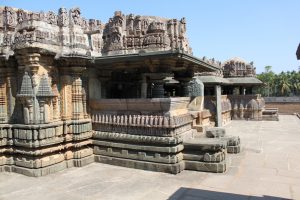
Amritapura, Am temple
OB03079 Poḷonnaruva Slab of Sāhasa-Malla
IN03099 Poḷonnaruva Slab Inscription of Sāhasa-Malla
The inscription is incised on both sides of a quadrangular slab, which was discovered sometime before 1874, standing upright at a spot north of the Häṭadāgē in Poḷonnaruva. The text is mostly in Sinhalese but two Sanskrit stanzas in śārdūlavikrīḍita metre make up the first and last five lines; these stanzas are separated from the rest of the text by fish emblems. The inscription gives an account of the parentage and ascent to the throne of Siri San̆gabo Kāliṅga Vijaya-Bāhu, noting that he was the (half-)brother of king Niśśaṅka-Malla and assumed the biruda epithet Sāhaṣa-Malla. It then records that Sāhaṣa-Malla appointed the general Lak-Vijaya-Sin̆gu-Senevi as his prime minister and granted him much wealth.
Whereas most Sri Lankan inscriptions of this period are dated only by the regnal years of ruling monarchs, this record contains a date in the Buddha-varṣa and thus provides a fixed point of historical reference within broader chronologies of the period. The date given in the inscription is 1743 years, 3 months and 27 days of the Buddhavarṣa, Wednesday, the twelfth day of the bright fortnight of the lunar month of Binera (Bhādrapada, Aug.-Sept.). Following Fleet (1909: 331), Wickremasinghe identified this date with Wednesday 23 August 1200 A.D. It refers to Sāhasa-Malla’s anointment as king and not the incision of the inscription. However, the grant recorded in the inscription is described as having taken place in the first year of the king’s reign (between August 1200 and August 1201 A.D.).
OB03078b Am̆bagamuva Rock 2 of Vijaya-Bāhu I
OB03078a Am̆bagamuva Rock 1 of Vijaya-Bāhu I
OB03078 Am̆bagamuva Rocks of Vijaya-Bāhu I
IN03098 Am̆bagamuva Rock Inscription of Vijaya-Bāhu I
The inscription is engraved on two boulders on the summit of a hill in Am̆bagamuva, a small village near Nāwalapiṭiya. The text outlines king Vijaya-Bāhu I’s parentage, his qualities as both a war lord and a benevolent ruler, and his victory over the Tamil forces. The inscription then records the king’s offerings to the Buddha’s footprint on Adam’s Peak, his improvements to the footprint’s shrine, and his charitable grants to pilgrims visiting the area. These grants are followed by the usual statement of ‘sanctions’ in respect of the villages dedicated to the shrine.
The date of Vijaya-Bāhu’s benefaction to the pilgrims of Adam’s Peak is given in the inscription as the seventh day of the waxing moon in the month of Män̆dindina (February–March) in the thirty-eighth year of his reign. This king’s Polonnaruwa rule began in 1070 A.D. and his coronation took place about two years later, thus placing the date of the benefaction around 1107. Since Vijaya-Bāhu I died in 1110, this must have been one of his last charitable acts. The specific date of the incision of the inscription is not given. However, as the text is situated in one of the villages affected by the benefaction, it may be presumed that it was incised not long after the grant was made.
OB03077 Räkiṭipe Pillar Fragment of Līlāvatī
IN03097 Räkiṭipe Pillar Inscription of Līlāvatī
The inscription is engraved on a stone fragment found between the years 1906 and 1912 in the village of Räkiṭipe in Unantänna-vasam, Diyatilaka kōrale in the Nuvara Eliya District. The abrupt ending of the inscription and the sun and moon emblems carved above the text indicate that the stone originally formed the top of a square pillar. The rest of the pillar is missing. As the extant fragment features only the first ten lines of the inscription, it is not possible to say what the subject-matter was. However, it seems from the first clause that the inscription recorded a grant of land or some other benefaction in the reign of Līlāvatī, the Queen-dowager of Parakkama-Bāhu I who ruled as sovereign in her own right for three separate periods, first in 1197, then in 1209-10 and finally in 1211-12. On the basis of palaeographic considerations, Wickremasinghe conjectures that this inscription may date to 1211 A.D., when Līlāvatī was installed on the throne for the third time, governing for seven months until deposed by the Pāṇḍyan King Parakkama.