Standing figure of Ambikā with an inscription of Bhoja
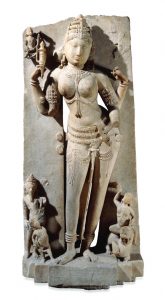
Standing figure of Ambikā from Dhār mentioning king mentioning king Bhoja.Collection of the British Museum, no. 1909,1224.1
Madīnat az-Zahrā (مدينة الزهراء). Kufic inscription (INAND0001) on an alabaster arch.
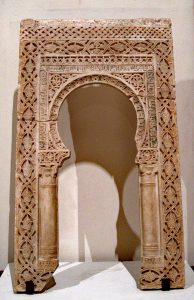
Madīnat az-Zahrā. (مدينة الزهراء). Alabaster arch with Kufic inscription.
Madīnat az-Zahrā. (مدينة الزهراء). Alabaster arch (OBAND00001) with Kufic inscription (INAND00001)
Madīnat az-Zahrā. Alabaster arch with Kufic inscription.
OB03087 Oruvaḷa Copper Plate
IN03107 Oruvaḷa Sannasa
The sannasa (land grant) is engraved on both sides an oblong copper-plate. There are fifteen lines of text on the observe and a further fifteen lines on the reverse. Writing in the late 1920s, Codrington recorded that the plate “has for many years been in the possession of Mr W. P. Ranasinha, Notary Public”. The latter’s son – A.G. Ranasinha Esq., C.M.G., C.B.E. – lent it to an exhibition organised by the Historical Manuscripts Commission in 1952.
The sannasa records a grant of land to two Brahmans – one Potā Ojjhalun and his nephew Avuhaḷa Ojjhalun of the Śān̆ḍiḷya gotra. As the sannasa relates, these Brahmans served as chief purohita “until His Majesty our King Mahā Parākrama Bāhu…had worn the crown fifty-five times” (i.e. had reigned for fifty-five years). Kings of this period wore the state crown every year on the anniversary of their coronation, hence a king who wore the crown fifty-five times must have reigned for fifty-five years. In recognition of their service, the Brahmans received for their maintenance the village of Oruvaḷa in Aturugiri Kōralē. Subsequently another king made this village a perpetual dānakṣetra in favour of the nephew and also granted him another village in the neighbourhood. Avuhaḷa Ojjhalun, not content, applied either to the same king or to one of his successors for a copper-plate charter confirming that the land held by him was permanently declared a dānakṣetra subject to an annual payment of fifteen fanams to the god Vishṇu. In answer to this request, the present sannasa was issued by king Siri San̆gabo Śrī Parākrama Bāhu at Jayavarddhanapura Kōṭṭē in the fourth year of his reign.
Codrington identifies Mahā Parākrama Bāhu – the king served by the two Bhamans – as Parākrama Bāhu VI, who reigned from 1412 (or 1415, according to certain historical sources) until 1467 A.D. However, the identity of Siri San̆gabo Śrī Parākrama Bāhu – the king who issued the sannasa – is less certain. Kings Parākrama Bāhu VII, VIII and IX are all possibilities, although it is most likely to have been one of the first two. On palaeographic grounds, Codrington favours Parākrama Bāhu VIII. Oruvaḷa (Oruwala), the village mentioned in the grant, is situated near Aturugiriya, about three miles south-south-west of Nawagamuwa.
OB03086 Poḷonnaruva Laṅkātilaka Inscribed Guard-Stone

Lankatilaka Vihara, Polonnaruwa
IN03106 Poḷonnaruva Laṅkātilaka Guard-Stone Inscription of Vijaya-Bāhu IV
The inscription was discovered on the inner face of the left guard stone of the east entrance to one of the buildings in the Laṅkātilaka Vihāra in Poḷonnaruva. The discovery was noted by H. C. P. Bell in the Annual Report of the Archaeological Survey of Ceylon for 1910–1911. Although bad weathering has rendered the middle lines of the inscription unreadable, the rest of the text is perfectly legible. The inscription consists of seventeen lines in Pāli. The composition is metrical, the whole text being framed in two gāthās. The first half of the first gāthā records that king Parakkama-Bāhu I (r. 1153–1186 A.D.) built the Laṅkātilaka Vihāra; the other half is illegible but seems to deal with some repair works to a wall of the aforementioned temple. The second gāthā tells us that the Laṅkātilaka Vihāra fell into a state of disrepair for one hundred years until king Vijaya-Bāhu IV (r. 1270–1272 A.D.) had it completely rebuilt. The Mahāvaṁsa confirms that the Laṅkātilaka Vihāra was built by Parakkama-Bāhu I. It further notes that, towards the end of the reign of his father Parakkama-Bāhu II (r. 1236–1269 A.D.), the future Vijaya-Bāhu IV made extensive repairs to temples and shrines in Poḷonnaruva. Taking this evidence together with the text of the guard-stone inscription, it is clear that the Laṅkātilaka was one of the structures repaired during this campaign of restoration. However, Wickremasinghe was unable to determine whether Vijaya-Bāhu IV had had the inscription engraved on an existing guard-stone which was already in situ or whether the text had been incised on a new stone added to the temple entrance during the repair works.
OB03085 Kantaläi Gal-Āsana Inscription of Kitti Nissaṅka-Malla
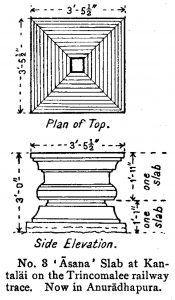
Diagram of the Kantaläi gal-āsana. Published in: Wickremasinghe, Don Martino de Zilva. (1912-27). ‘No. 42. (Reg. No. 3.) Kantaläi Gal-Āsana Inscription of Kitti Nissaṅka-Malla (1187–1196 A.D.),’ Epigraphia Zeylanica 2, p. 283.
IN03105 Kantaläi Gal-Āsana Inscription of Kitti Nissaṅka-Malla
The inscription is engraved around the four sides of a stone seat (gal–āsana), which was discovered in 1921 in the village of Kantaläi on the Trincomalee Railway and afterwards removed to Anurādhapura. The text identifies the stone seat as the one that king Nissaṅka-Malla, after returning from his Indian campaign, used to occupy whilst witnessing the various diversions such as alms-giving, dancing, singing, etc., in the Pārvatī-satra erected at his request in Caturveda-Brahmapura, ‘the city of the Four-Vedic Brahmans’. By way of an introduction, the inscription also includes a bombastic account of Nissaṅka-Malla’s military achievements and charitable acts. Virtually identical accounts are commonly found in other gal-āsana records of this king. The Kantaläi inscription is not dated but, since it references his tours of inspection and his expedition to India, it was probably composed towards the end of his short but eventful reign, which spanned nine years, beginning in 1187 and terminating in 1196. If Kantaläi was the original site of the seat, then this locality must once have been the town called Caturveda-Brahmapura, which was probably occupied mostly by Brahman families for whose benefit an almshouse called Brāhmaṇa-satra was also established by Nissaṅka-Malla.
OB03084 Poḷonnaruva Gal-Vihāra Inscribed Rockface

Gal Vihara, Polonnaruwa. Photograph by John & Co. Published in: The Buddhist Annual of Ceylon, vol. 3, no. 2 (1928), p. 89.
.jpg)
The inscription is engraved on the smoothed area of sloping rock to the right of the cave entrance.