IN03060 Pālu Mäkiccǟva Rock Inscription of Gaja Bāhu I
The inscription is situated on a rock at the vāṇa or “spill-water” of an abandoned tank known as Pālu Mäkiccǟva. The tank is situated in the jungle, about 120 yards off the high road to Trincomalee, 16 miles from Anurādhapura. The inscription is composed of six lines, written in Southern Brāhmī alphabet of the latter part of the 2nd century A.D. It records the donation of 5000 kārṣāpaṇas from king Gamiṇi Abaya to the Buddhist priesthood of Tubaraba (Thūpārāma). Gamiṇi Abaya (or Gajabāhuka Gāmaṇī Abhaya) is described as having created the Vaḍamanaka tank in the Upala district but not the Pālu Mäkiccǟva tank, which he appears only to have repaired or deepened. The inscription identifies the Pālu Mäkiccǟva tank as the Abhivaḍḍhamānaka-vāpi tank and says that it was constructed by Gamiṇi Abaya’s grandfather.
OB03039 Moragoḍa Pillar of Kassapa IV
IN03059 Moragoḍa Pillar Inscription of Kassapa IV
The pillar was first discovered sometime in or before 1886 by H. Parker in the forest below the embankment of the Padaviya Tank “at the site of an ancient town which is now called Moragoḍa”. It was still there, “lying prone among the ruins”, when Bell and Wickremasinghe visited the spot in October 1891. The pillar is inscribed on all four sides in the Sinhalese alphabet of the 10th century A.D. The inscription is dated in the sixteenth year of reign of king Kasub Sirisaṅgbo, identified as Kassapa IV (r. 912-929 A.D.) It proclaims the grant of certain immunities to lands irrigated by the waters of the Padonnaru tank.
Udaypur उदयपुर (Madhya Pradesh). Record of a temple procession in V.S. 1481
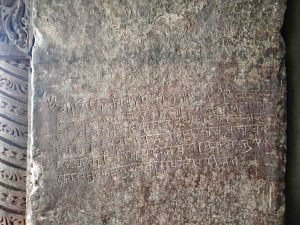
Record of a procession of the god Udalēsvara at Śiva temple, Udaypur (उदयपुर Madhya Pradesh) in saṃvat 1481. Engraved in 6 lines on the left jamb of the eastern entrance to the maṇḍapa. Working transcription prepared by Saarthak Singh (latest version 25/11/2019).
OB03038 Buddhannehäla Pillar
IN03058 Buddhannehäla Pillar Inscription
The inscribed stone pillar was discovered by Wickremasinghe and Bell in 1891 in Buddhannehäla (Buddhanagehela) in Kun͂chuṭṭu Kōrale, North-Central Province, about seven miles north of the ruins of Padaviya. Five caves and one dāgaba were found in Buddhannehäla and the present inscription was discovered in Cave No. 3. The pillar was placed upside down to serve as a door-jamb of a Śaiva shrine of about the eleventh or early twelfth century A.D. and was evidently brought there from elsewhere. Written in the Sinhalese alphabet of the 10th century A.D., the inscription covers the four sides of the pillar. On the first side, the inscription is surmounted by a large śrī and, above that, an emblem of the sun or a lotus. On the fourth side, a crow and a dog are cut underneath the inscription to indicate that whosoever transgresses the rules enjoined shall be born in the future as these animals. The inscription records regulations concerning the management of lands (fields, water, employees, cattle, sowing). Its use of the expression abhiṣekayen daru (‘son by sacred sprinkling’) indicates the prevalence of certain Brahmaṇic or more likely northern Buddhist (Mahāyāna) rites not sanctioned in the southern Buddhist Church. The inscription is dated in the third year of the reign of His Majesty Abhā Salamevan. This name (biruda) was used by a number of Sri Lankan monarchs. It may refer in this instance to Kassapa V (r. 929-939).
OB03037 Puliyaṉ-kuḷam Slab (C/8) of Udā Mahayā
IN03057 Puliyaṉ-kuḷam Slab-Inscription (C/8) of Udā Mahayā
The inscription was unearthed in 1898 at the image-house of the ruined monastery at Puliyaṉ-kuḷam. The slab is pointed at the lower end and must have originally stood upright. It is engraved with 44 lines in the Sinhalese alphabet of the last quarter of the 10th century or of the first quarter of the 11th century A.D. The inscription records the merits and great deeds of the Chief Governor Udā Mahayā.
OB03036 Slab of Queen Līlāvatī
IN03056 Slab-Inscription of Queen Līlāvatī
The slab was seen by Wickremasinghe in the Archaeological Commissioner’s Office at Anurādhapura. Its original location is uncertain but, as it was placed together with objects from Puliyaṉ-kuḷam, a small village situated two and a half miles north-east of Anurādhapura, it is assumed to have come from the same locality. The material from Puliyaṉ-kuḷam included several inscribed slabs from the piḷima-gē and the stone revetment of the dāgaba, three of which were marked ‘C/6’, ‘C/7’ and ‘C/8’. The present inscription is marked ‘D/8’. It is written in the Sinhalese alphabet of the 12th and 13th centuries A.D. and records the good deeds of the queen Līlāvatī, wife of King Parakkama Bāhu I. It tells us that she ruled the island with the aid of a Council of Ministers and that she built an almshouse in Anurādhapura. There is no date given in the inscription but her reign can be dated by other sources. Līlāvatī was on the throne first from 1197 to 1200 A.D., secondly in 1209 and lastly in 1211. The present grant was probably made during the first period, when the government was administered by Kitti Sēnāpati.