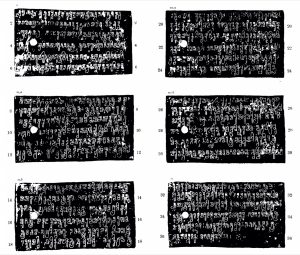
Copper plate charter of Pravarasena II found at the village of Jāmb.
Seen. Success! Hail! From Nandivardhana—
By the order of the illustrious Pravarasêna (II), the Mahârâja of the Vâkâṭakas, who is a fervent devotee of Mahêśvara, who, by the grace of Śambhu, has established the Kṛitayuga (Golden Age) (on the earth), who was born of Prabhâvatîguptâ, the daughter of the Mahârâjâdhirâja, the illustrious Dêvagupta, and who is the son of the Mahârâja, the illustrious Rudrasêna (II), who acquired an abundance of prosperity by the grace of the Divine (Lord) Chakrapâni (Vishnu), and who was the son of the illustrious Pṛithivîshêṇa (I), the Mahârâja of the Vâkâṭakas, who was intensely devoted to (the god) Mahêśvara, who was endowed with truthfulness, straightforwardness, compassion, heroism, valour, political wisdom, modesty, high-mindedness, intelligence, devotion to worthy persons, and with the state of being a righteous conqueror, purity of mind, and such other qualities, who had sons and grandsons and a continuous supply of treasure and army which had been accumulating for a hundred years, who conducted himself like Yudhishṭhira, and who was the son of the illustrious Rudrasêna (I), the Mahârâja of the Vâkâtakas and the son of Gautamîputra, who was intensely devoted to (the god) Svâmi-Mahâbhairava, who was the daughter’s son of the illustrious Bhavanâga, the Mahârâja of the Bhâraśivas, whose royal family was created by Śiva, who was greatly pleased by (their) carrying the linga of Śiva like a load placed on (their) shoulder, and who were besprinkled on their head with the pure water of the (river) Bhâgîrathî that had been obtained by their valour, who was the son of the illustrious Pravarasêna (I), the Mahârâja of the Vâkâtakas, the Samrât (Universal Monarch), who performed the Agmshtôma, Âptôryâma, Ukthya, Shôḍaśin, Atirâtra, Vâjapêya, Brihaspatisava, Sâdyaskra and four Aśvamêdhas, and who was of the Vishnuvriddha gôtra
(Line 17) The village named Kôthuraka situated in the âhâra of Supratishṭha, which (is) to the west of the river Umâ, to the north of Chinchâpallî, to the east of Bônthikavâṭaka (and) to the south of Maṇḍukigrâma, has been donated (by Us) to the Brahmachârin (named) Kaluṭtaka, who has performed a gana-yâga and who belongs to the Taittirîya śâkhâ
(Line 20) Wherefore, Our officials of noble birth, who are employed by the order of the Sarvâdhyaksha (General Superintendent) and who exercise their authority by (Our) command, and (Our) soldiers and policemen should be directed by the (following) command which is already well-known (to them) —
“Be it known to you that in order to increase Our religious merit, life, power, victory and prosperity, to secure Our well-being in this world and the next and to obtain blessings for Ourself, We have given here in (Our) victorious place of religious worship, with the pouring out of water, (this village) as a gift not previously made
And We grant the following exemptions which are incidental to a village bestowed on a Brâhmana proficient in the four Vêdasand are appropriate, as approved by formed kings— It is not to pay taxes, it is not to be entered by soldiers and policemen; it does no entitle (the State) to customary cows and bulls, it does not (also) entitle it to (royalties on) flowers and milking, it is exempt from (the obligation to provide) grass, hides as seats and charcoal (to touring royal officers), it is exempt from (royalties on) the purchase of fermenting liquois and the digging of salt, it is free from all kinds of forced labour, it is donated together with (the right to) hidden treasures and deposits (and) together with major and minor taxes it is to be enjoyed as long as the sun and the moon (will endure) and it is to follow the succession of sons and son’s sons None should cause an obstruction while (the donee or his successor) is enjoying it (This grant) should be preserved and increased by all means. And whoever disregarding Our order, will himself cause or make (others) cause even the slightest obstruction, upon him, when complained against by the Brâhmanas, We will inflict punishment together with a fine”
(Line 32) In showing thus Our regard to religion, We, in order to avoid mention of the meritorious deeds already done, do not refer to (Our) care and protection of the grants of many past kings
And the following verse sung by Vyâsa should be regarded as an authority on this point:—
(Here occurs an imprecatory verse)
(Line 35) (This charter has been written) by Nâgavarman on the twelfth (lunar day) of the bright (fortnight) of the month Âśvayuja in the second (regnal) year, Chakradêva being the Dûtaka.