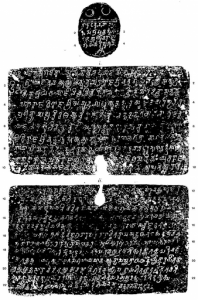
The charter records the donation of the village Uṅguṇa (or Daṅguṇa) to Chanālasvāmin by Prabhāvatī Guptā during the 13th year of her reign as Regent for her minor son. The charter was issued from Nāndivardhana, the modern Nandardhan or Nāgardhan near Ramtek.
Seal: This is the enemy-chastizing command of the mother of the young prince, the ornament of the Vâkâṭakas, who has obtained sovereignty in course (of succession).
(Ll. 1-10) (In margin, ‘seen’) Success! From (the town of) Nândivarddhana; the illustrious Prabhâvati-guptâ of the Dhâraṇa gôtra, born of the illustrious Mahâdêvî Kubêranâgâ, who, herself born of the Nâga family, was an ornament to both the families (of her father and husband); immensely devoted to the Divine (Vishṇu); chief queen of the illustrious Mahârâja Rudra-sêna of the Vâkâṭakas; mother of the illustrious Yuvarâja Divâkara-sêna; and daughter of the illustrious Mahârâjâdhirâja Chandra-gupta (II), the great devotee of the Divine (Vishṇu), the bestower of many thousands of crocs of cows and gold, whose fame was tasted by the waters of the four oceans, the exterminator of all princes, who had no rival on earth, the excellent and the most favoured (lit. accepted by His Majesty) son of the illustrious Mahârâjâdhirâja Samudra-gupta, born of the great queen Kumâra-dêvî, daughter’s son of the Lichchhavi (chief), the performer of several horse-sacrifices, the excellent son of the illustrious Mahârâja Ghaṭôtkacha, who had Gupta as the first king;
(L. 10) After announcing (her) well-being, commands the village householders, Brâhmans and others, of the village of Danguṇa, in the Supratishṭha Âhâra to the east of (the village) Vilavaṇaka, to the south of the village of Śîrsha, to the west of Kadâpiñjana and to the north of Sidivivaraka:—
(L. 13) Be it known to you that, on (this) twelfth (day) of the bright (half) of (the month of) Kârttika, we have, for the accumulation of our religious merit, bestowed, as a grant not previously made, this village with (a libation of) water upon the great devotee of the Divine (Lord) the Âchârya Chanâla-Svâmin, after having first offered it at the feet (lit. root of the feet) of the Divine (Lord Vishṇu); hence you should carry out all injunctions with proper deference.
(L. 15) We there confer the exemptions incident to a village belonging to a community of Châturvidyas, (as) approved by former kings; (it is) not to be entered by soldiers and umbrella-bearers; not (yielding the right) to pasturage, hides, charcoal, the purchase of fermenting drugs, and mines; not (entitling to) the succession (of cows and bulls); not to have an animal-sacrifice; not (to have the right of) abundance of flowers and milk; with the hidden treasures and deposits, with klṛipta and upaklṛipta.
(L. 18) So, this (grant) should be maintained and increased by future kings. Whosoever, disregarding this charter, shall make or cause to make the slightest molestation, upon him, on his being reported by the Brâhmans, we will inflict punishment together with a fine.
(L. 20) And on this point there is a verse, sung by Vyâsa: He who confiscates land given by himself or by others incurs the sin of one who kills a hundred thousand cows.
(L. 22) And this charter is written in the thirteenth year; engraved by Chakkradâsa.