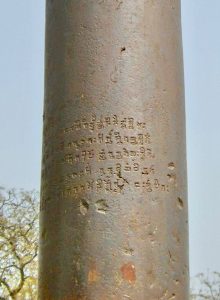
Delhi, Iron pillar, detail of the inscription (Wikicommons)

1) On whose arm, fame was inscribed by the sword—when, in battle in the Vaṅga territory, he dashed back with his breast—the enemies who, uniting together, came upon (him) —by whom crossing the seven mouths of the Sindhu, the Vāhlikas were conquered in battle—by the breezes of whose valour the southern ocean is still perfumed;
2) Who, the king, is quitting this go (earth), as if dejected, has resorted to another go (intermediate region); who, though he has, in body, gone to the land (avani) conquered for (religious) rites, has remained on earth (kshiti) by fame—(and) whose great pratāpa (valour), (though it is now) the conclusion of the exertion of (him) who had destroyed his enemies, does not as yet leave the earth like the pratāpa (heat) of the conflagration in a great forest (though it has now) subsided;
3) By that king, who acquired sole supreme sovereignty on earth by (the power of) his own arm and for very long (and) who having the name Candra and bearing beauty of face like that of the full-moon, with devotion having fixed (his) mind upon Viṣṇu, this lofty flag-staff of the divine Viṣṇu was set up on the hill, Viṣṇupada.