INBG00018 Bodhgaya inscription of year 64 on the pedestal of a seated Buddha
Bodhgayā (बोधगया), Bihār. Inscription (INBG00018) on the pedestal of a sandstone Buddha image (OBBG00018). Provisional edition by Dániel Balogh, see Concordance for bibliographic data.
OBBG0001 Bodhgayā stone slab with vajrāsana inscription
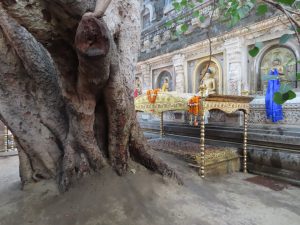
OBBG0001 Bodhgayā, Bihār. The so-called vajrāsana or diamond throne under the Bodhi tree at the Mahābodhi temple in Bodhgayā. Photograph by Daniela De Simone.
INBG0001 Bodhgaya vajrasana inscription on stone slab
Bodhgayā (बोधगया), Bihār. Inscription (INBG0001) on the narrow edges of the upper surface of a sandstone slab, the so-called vajrasāna (OBBG0001). Edition here that of Balogh in De Simone et al. (2020), see Concordance for bibliographic data.
OBBG00016 Bodhgayā coping stone with and an inscription mentioning gaṃdhakuṭī
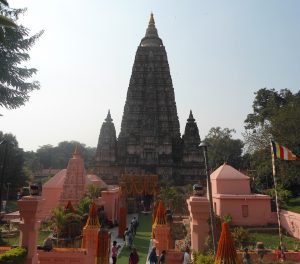
OBCH0005 Bodhgayā stone slab with the seven Buddhas, Maitreya and a Chinese inscription

Bodhgayā (बोधगया, often Bodh Gaya, Bihār).
Stone slab (OBCH0005) with the seven Buddhas (saptatathāgata 過去七仏) and Maitreya (弥勒仏), inscribed with a Chinese inscription (INCH0005) mentioning the figures, and the monks from China who commissioned the sculpture. Now in the Indian Museum, Kolkata.
INCH0005 Bodhgaya Chinese inscription on a slab with the seven Buddhas and Maitreya
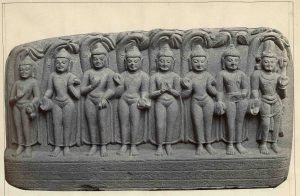
Bodhgayā (बोधगया) Chinese inscription (INCH0005) on a slab (OBCH0005) with the seven Buddhas (saptatathāgata 過去七仏) and Maitreya (弥勒仏). English edition below that of Bagchi and Ta-Fu (2011), see Concordance for bibliographic data. Working transcription (02/2021).
INBG00016 Bodhgaya gandhakuti inscription on a coping stone
Bodhgayā (बोधगया), Bihār. Inscription (INBG00016) on the inner side of a coping stone of the vedikā (OBBG00016) recording an endowment for offerings made in the gaṃdhakuṭī (“the perfumed chamber of the Buddha”, i.e. the sanctum of the Mahābodhi temple). Edition here that of Tsukamoto 1996 (based on Bloch 1912), see Concordance for bibliographic data.
INCH0004 Bodhgaya Chinese inscription of Huaiwen dated CE 1033 in the second mingdao year of the Song emperor Zhenzong
Bodhgayā (बोधगया Bihār). Chinese inscription of Huaiwen dated in the second year of 明道 Míngdào (CE 1033) of the Song emperor 真宗 Zhēnzōng. Edition here that of Chavannes (1896), see Concordance for bibliographic data. Working edition (02/2021).
[top portion]:
1. 大宋皇帝
2. 皇太后為
3. 太宗皇帝
4. 建塔壹座
[main text: 1.] 大宋
[2.] 聖文睿武仁明孝德皇帝.
[3.] 應元宗德仁壽慈聖皇太后.謹遣僧懷問.詣摩伽陀
[4.] 國奉為資薦
[5.] 太宗至仁應道神功聖德文武睿烈大明廣孝皇帝.
[6.] 於金剛座側.建塔一座.
[7.] 太宗皇帝伏願.高步 天宮.親承
[8.] 佛記書證. 真仙之位常居.
[9.] 釋梵之尊誕錫. 威靈永隆
[10.] 基業時明道二年.歲次癸酉.正月十九日記. 丙 日予
OBCH0004 Bodhgaya stone stele with a Chinese inscription dated CE 1033
Bodhgayā (बोधगया, often Bodh Gaya, Bihār).
Stone stele with Chinese inscription dated in the second year of 明道 Míngdào (CE 1033) of the Song emperor 真宗 Zhēnzōng.