OB03130 Poḷonnaruva Council Chamber Inscribed Pillar
IN03158 Poḷonnaruva Council Chamber Pillar Inscription
This inscription is engraved on all four sides of a quadrangular stone pillar, which has been broken into two nearly equal pieces. These pieces are now joined together and preserved in the Archaeological Museum at Anurādhapura. The fragments were discovered in the vicinity of Niśśaṁka Malla’s Council Chamber on the embankment of the Tōpāväva at Poḷonnaruva, as recorded in the Annual Report of the Archaeological Survey of Ceylon for 1909, p. 39. However, it seems that the pillar did not originate in this location and was instead brought there from somewhere else to serve an architectural purpose, possibly as a tread in a flight of steps.
The inscription is dated in the fourth year of a king referred to by his viruda title of Abhaya Salamevan. H. C. P. Bell (Annual Report of the Archaeological Survey of Ceylon for 1909, p. 39) identified this monarch with Kassapa V (r. 929–939) but, as there is nothing besides the palaeography to aid this identification, we cannot be quite certain. Senarath Paranavitana suggests that, paleographically, the record could equally be ascribed to Dappula V (r. 940–952). Both Kassapa V and Dappula V used the viruda title of Abhaya Salamevan.
The inscription records the grant of immunities to certain lands held by an individual, whose name is not clearly legible, as a pamaṇu (freehold) on condition of paying, annually, one pǟḷa of dried ginger to a hospital founded by Doti Valaknä. The custom of freeholders paying a small quit-rent to a religious or charitable institution was relatively common in medieval Sri Lanka and there are a number of surviving inscriptions recording such arrangements, the vast majority of which are written in a similar style. Indeed, in the ninth and tenth centuries, there seems to have been a specific formula for such documents. However, the present inscription departs almost entirely from this familiar model, using instead a much rarer formulation (see Misc. Notes for more detail). Senarath Paranavitana identified only two other fragmentary inscriptions that follow the same pattern as this record. One was from Rajamahavihāra at Vihāregama in the Dam̆badeṇi Hatpattu of the Kuruṇǟgala District (IN03159); and the other was found at a place named Mäda-Ulpota in Gan̆gala Pallēsiya Pattuva, Mātalē East (IN03160). These two inscriptions, though not of much interest in themselves, enabled Paranavitana to decipher certain sections of the present inscription where the writing is not clearly legible.
IN03153 Saṁgamu Vihāra Rock Inscription
The inscription is cut into the rock near the ancient Buddhist monastery situated on the low, rocky hill by the Meddeketiya tank at Saṁgamuva, a village about two miles to the north-east of Gokarälla, in the Häḍahaya Kōraḷē of the Kuruṇǟgala District. A series of over one hundred steps, cut into the bare side of the rock, lead up the side of the hill to a plateau, upon which stand the ruins of an old stupa and other monastic buildings. The inscription is engraved at the top of the steps, to the left as one ascends the hill. It was copied for the first time by Senarath Paranavitana in 1931 (see Archaeological Survey of Ceylon Annual Report for 1930–31, p. 5). The text is written in Sinhalese, apart from the last four lines, which consist of a Sanskrit verse in the Vasantatilakā metre, though nearly half of this verse is no longer legible.
The inscription is of exceptional historical importance, since it records an alliance between two princes called Gajabāhu and Parākramabāhu, who can be identified as Gajabāhu II (r. 1131–1153) and the future Parākramabāhu I (r. 1153–1186). The Mahāvaṁsa records how Parākramabāhu, after consolidating his position in the principality of the Dakkhiṇadesa to which he succeeded on the death of his uncle Kittisirimegha, undertook a campaign against his cousin Gajabāhu II with the object of making himself ruler of the island of Sri Lanka. Eventually, the two princes came to a peace settlement, as recorded in the present inscription. The two princes speak in the first person in this inscription. After introducing themselves by name, they come to the matter of the agreement. The first clause states that they will not wage war against each other for the rest of their lives. Although now partly damaged, the second clause seems to declare that, whichever prince dies first, his possessions will pass to the surviving prince. Since Gajabāhu was by some margin the older of the two, this clause essentially amounts to him bequeathing his kingdom to Parākramabāhu. The third clause is now almost completely illegible. By the fourth and final clause of the treaty, the two princes enter into an offensive and defensive alliance, declaring that any king who is an enemy of one of them, is an enemy of both. Paranavitana interpreted this clause as being directed against Mānābharaṇa, the ruler of Rohaṇa, who also had designs on Gajabāhu’s throne. The agreement concludes with imprecations against both princes if they act contrary to its terms. It is not clear why this record was engraved at the Saṁgamu Vihāra. Although it was within the territories under Parākramabāhu’s rule, there is nothing to prove that the place was close to his residence, even temporarily. Paranavitana posited that the treaty may have been brokered by a monk who resided at the vihara but this is only conjecture.
IN03152 Galle Trilingual Stele – Chinese Inscription
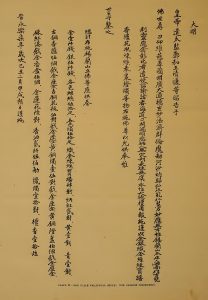
Galle (Sri Lanka). Stele of Zheng He (鄭和), transcription of Chinese portion. (Zenodo).
The inscription is engraved on a stone slab discovered in 1911 by H. F. Tomalin, the Provincial Engineer at Galle, in a culvert near the turn to Cripps Road within that town and afterwards moved to the Colombo Museum. The slab features inscriptions in three different languages, enclosed within a floral border: Tamil (top-left, IN03150), Persian (bottom-left, IN03151) and Chinese (right). The Chinese inscription is dealt with here.
Following the discovery of the slab, the Chinese inscription was transcribed and translated by Edmund Backhouse. Like the Tamil inscription, it is dated in the second month of the seventh year of Yongle (永樂), the Chinese emperor whose reign began in 1403. The text features praise and offerings dedicated by the Chinese emperor, through his envoys Ching-Ho and Wang Ch’ing Lien, to the Buddha. The other two inscriptions on the slab feature similar lists of offerings but the beneficiary is different in each case, being a Hindu cult deity in the Tamil text and an Islamic saint or shrine in the Persian. It therefore appears that, when the Chinese arrived in Sri Lanka, they made gifts of equal value to several different religious traditions of the region and registered these gifts on the same stele.
IN03151 Galle Trilingual Stele – Persian Inscription
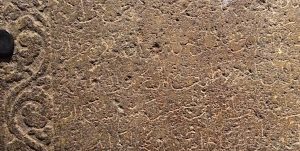
Galle (Sri Lanka). Stele of Zheng He (鄭和), detail of Persian portion. (Zenodo).
The inscription is engraved on a stone slab discovered in 1911 by H. F. Tomalin, the Provincial Engineer at Galle, in a culvert near the turn to Cripps Road within that town and afterwards moved to the Colombo Museum. The slab features inscriptions in three different languages, enclosed within a floral border: Tamil (top-left, IN03150), Persian (bottom-left) and Chinese (right, IN03152). The Persian inscription is dealt with here.
Following the discovery of the slab, the Chinese inscription was successfully transcribed and translated by Edmund Backhouse. However, Rao Bahadur H. Krishna Sastri (Assistant Superintendent for Epigraphy, Madras) and J. Horrovitz (Epigraphist for Moslem Inscriptions in India) failed in their efforts to decipher the Tamil and Persian texts respectively. Sometime later, the Tamil inscription was transcribed and translated for the third volume of Epigraphia Zeylanica (1933: 331–341) by Senarath Paranavitana, who benefitted from having access to Backhouse’s translation of the Chinese text. The Persian inscription is badly damaged but Khwaja Muhammad Ahmad of the Archaeological Department of H. E. H. the Nizam’s Dominions was able to compile a text and translation of the legible portion, which was published in 1933 as an appendix (Appendix B) to Paranavitana’s account of the Tamil inscription.
Following the discovery of the slab, the Chinese inscription was transcribed and translated by Edmund Backhouse. Like the Tamil inscription, it is dated in the second month of the seventh year of Yongle (永樂), the Chinese emperor whose reign began in 1403. The text features praise and offerings dedicated by the Chinese emperor, through his envoys Ching-Ho and Wang Ch’ing Lien, to the Buddha. The other two inscriptions on the slab feature similar lists of offerings but the beneficiary is different in each case, being a Hindu cult deity in the Tamil text and an Islamic saint or shrine in the Persian. It therefore appears that, when the Chinese arrived in Sri Lanka, they made gifts of equal value to several different religious traditions of the region and registered these gifts on the same stele.
OB03125 Galle Trilingual Stele of Zheng He (鄭和)
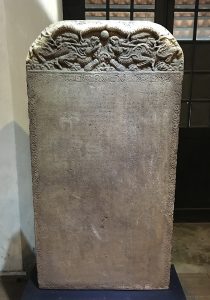
IN03150 Galle Trilingual Stele – Tamil Inscription
The inscription is engraved on a stone slab discovered in 1911 by H. F. Tomalin, the Provincial Engineer at Galle, in a culvert near the turn to Cripps Road within that town and afterwards moved to the Colombo Museum. The slab features inscriptions in three different languages, enclosed within a floral border: Tamil (top-left), Persian (bottom-left, IN0351) and Chinese (right, IN0352). The Tamil inscription is dealt with here.
Following the discovery of the slab, the Chinese inscription was successfully transcribed and translated by Edmund Backhouse. However, Rao Bahadur H. Krishna Sastri (Assistant Superintendent for Epigraphy, Madras) and J. Horrovitz (Epigraphist for Moslem Inscriptions in India) failed in their efforts to decipher the Tamil and Persian texts respectively. Sometime later, the Tamil inscription was transcribed and translated for the third volume of Epigraphia Zeylanica (1933: 331–341) by Senarath Paranativana, who benefitted from having access to Backhouse’s translation of the Chinese text.
Like the Chinese inscription, the Tamil inscription is dated in the second month of the seventh year of Yuṅlo (Yung Lo), the Chinese emperor whose reign began in 1403 A.D. The text tells us that the Chinese emperor, having heard of the fame of the god Tenavarai-nāyaṉār in Sri Lanka, sent to him, through his envoys Ciṅvo and Uviṅcuviṅ, various kinds of offerings, of which a detailed list is given. Paranavitana notes that Tenavarai is the Tamil name for Devundara (Devunuvara), a settlement near Matara on the southern coast of Sri Lanka which was the centre of a cult dedicated to a deity known as Uppalavaṇṇa. Sometimes like the Purāṇic Viṣṇy in the Hindu tradition, this god was sometimes styled in Sinhalese ‘Devundara Deviyo’, which can be rendered in Tamil as ‘Tenavarai-nāyaṉār’. The other two inscriptions on the slab feature similar (though not identical) lists of offerings but the beneficiary is different in each case, being the Buddha in the Chinese text and an Islamic shrine or saint in the Persian. It therefore appears that, when the Chinese gained political ascendancy over Sri Lanka in 1409, they made gifts of equal value to several different religious traditions of the region and recorded these gifts on the same stone.
OB03124 Kaṭugaha-Galgē Pillar
IN03149 Kaṭugaha-Galgē Pillar Inscription
The inscription is engraved on a stone pillar, which now stands outside the cave at the ancient site known as Kaṭugaha-galgē (Katugahagalge) or Aturugiri Vihāra, situated about five miles to the north of Buttala in the Kan̆dukara Kōraḷē of the Ūva Province. The cave is situated on the steep side of a huge granite rock on top of which there is a small stupa now renovated. A part of the cave has been walled, in comparatively recent times, to form a shrine and six cells as living quarters for the monks. In front of the cave are remains of ancient structures, the stonework of which is plain and archaic and bespeaks an early date. The pillar, which has been broken into two unequal fragments, was not originally situated here, having been removed to this site from a neighbouring chena sometime in the nineteenth century.
Two other known pillars bear inscriptions identical to this one. One stands in the vicinity of the colossal stupa at Yudaganava, which is about four miles to the south of Katugahagalge, having been brought there from the neighbouring jungle in 1924. The other was found at Väligatta in Hambantoṭa district and now forms part of the collection at the Colombo Museum. In August 1927, Senarath Paranavitana visited Yadaganava and Katugahagalge and found that the pillars at these two places, as well as the one from Väligatta, were gavu (P. gāvuta) stones set up by Kāliṅga Cakravartti, i.e. Niśśaṁka Malla, who reigned from 1187 to 1196 A.D. H. W. Codrington subsequently brought to light six more of these gāvuta pillars in the same locality, most of them in a fragmentary condition. Codrington’s paper on these pillars, dealing particularly with the information they yield on the precise length of the yojana and gāvuta (ancient units of measure), was published in the Ceylon Journal of Science (Section G), vol. ii, pp. 129–134. Of all of these pillars so far known, only on the Katugahagelge pillar is the inscription completely preserved. The inscription indicates the pillar marked a gāvunta and it also includes a short homily addressed to the people of Rohaṇa and an account of the achievements and deeds of king Niśśaṁka Malla.