INIG1349 Inscription of VS 1349
INIG1349 [Provenance not recorded, possibly from Morena district]. On a stone slab. 17 lines, nāgarī, corrupt Sanskrit. Mentions the construction of a tank by mahatā Jaitasiṁha of Lodhā family when Cāhamāna Hamīradeva was ruling Śakambara. Now in the collection of the Archaeological Museum, Gwalior.
INIG1348c Kolāras Inscription of VS 1348c
INIG1348c āṣāḍha badi 11, Kolāras (Shivpuri). On a satī stone. 3 lines, nāgarī, Sanskrit. Mentions a satī, apparently of the queen of Govindarāja.
INIG134[?] Barokhar Inscription of VS 134[?]
INIG134[?] caitra śudi 8 guruvāra Barokhar (Morena). On a memorial stone. 17 lines, nāgarī, Sanskrit. Mentions śrīmad Gopāla. Not completely legible.
Pauni Donative Inscription of Visamitā (INNAG0001)
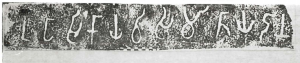
Pauni (पौनि Bhandārā district) Maharashtra. Donative Inscription of the upāsika Visamitā.
INIG1345a Pachrāi Inscription of VS 1345b
INIG1345b vaiśākha badi 2 śanivāra Pachrāi (Shivpuri). On a slab in the quadrangle of a temple complex. 18 lines, nāgarī, corrupt Sanskrit. Refers to the administration of mahāpradhāna rā˚ Haṁsarāja in the time of Gopāladeva of Narwar. Records the death of Vālha, the son of Kaccharāṇeju and probably the performance of satī by Sulathā the daughter of paḍihāra Salabhaṇe and [Hā]ju the daughter of rā˚ Anaisiha. Engraved by sūtradhāra Mitanka.
IN03025 Vessagiri Slab 2 Inscription B
Vessagiri, or more commonly in Sinhalese Vessagiriya, is the traditional name of a forest-bound cluster of rocks in Anurādhapura. The site features three hummock-boulders of gneiss rock in a line from north to south (Rock A, Rock B and Rock C). The hummocks are surrounded by the ruins of a monastery, which had its cells in the caves of Rocks B and C (twenty-three caves in total). Some of the caves are inscribed with dedications to the Buddhist priesthood, plus there are a number of other rock inscriptions at the site. In addition, two inscribed slabs associated with Vessagiri are preserved in the museum at Anurādhapura. One of the slab inscriptions (IN03023) is of the king Dappula V (A.D. 940-952) and records a royal offering to the Virāṅkurā monastery. The second slab is inscribed on its front and back with inscriptions of the king Mahinda IV (975-991) detailing benefactions made to the clergy of the monastery Bo-Upulvan-Kusub-giri Vehera. The inscription on the back of this slab is dealt with here (see IN03024 for the inscription on the front).
OB03020 Vessagiri Slab 2
IN03024 Vessagiri Slab 2 Inscription A
Vessagiri, or more commonly in Sinhalese Vessagiriya, is the traditional name of a forest-bound cluster of rocks in Anurādhapura. The site features three hummock-boulders of gneiss rock in a line from north to south (Rock A, Rock B and Rock C). The hummocks are surrounded by the ruins of a monastery, which had its cells in the caves of Rocks B and C (twenty-three caves in total). Some of the caves are inscribed with dedications to the Buddhist priesthood, plus there are a number of other rock inscriptions at the site. In addition, two inscribed slabs associated with Vessagiri are preserved in the museum at Anurādhapura. One of the slab inscriptions (IN03023) is of the king Dappula V (A.D. 940-952) and records a royal offering to the Virāṅkurā monastery. The second slab is inscribed on its front and back with inscriptions of the king Mahinda IV (975-991) detailing benefactions made to the clergy of the monastery Bo-Upulvan-Kusub-giri Vehera. The inscription on the front of this slab is dealt with here (see IN03025 for the inscription on the back).
OB03019 Vessagiri Slab 1
IN03023 Vessagiri Slab 1 Inscription
Vessagiri, or more commonly in Sinhalese Vessagiriya, is the traditional name of a forest-bound cluster of rocks in Anurādhapura. The site features three hummock-boulders of gneiss rock in a line from north to south (Rock A, Rock B and Rock C). The hummocks are surrounded by the ruins of a monastery, which had its cells in the caves of Rocks B and C (twenty-three caves in total). Some of the caves are inscribed with dedications to the Buddhist priesthood, plus there are a number of other rock inscriptions at the site. In addition, two inscribed slabs associated with Vessagiri are preserved in the museum at Anurādhapura (OB03019 and OB03020). The present inscription is engraved on one of the slabs. It dates from the reign of king Dappula V (A.D. 940-952) and records a royal offering to the Virāṅkurā monastery.