OB03089 Mannar Kacceri Pillar
IN03109 Mannar Kacceri Pillar Inscription
The inscription is covers all four sides of a quadrangular stone pillar, which stood in the early twentieth century in a corner of a room in the Kacceri (Government Agent’s Office) at Mannar. It is said to have been found in Māntai or Tirukkētīśvaram (or possibly in the bund of the Giant’s Tank) but the precise circumstances of its discovery are not recorded. The inscription details a grant of immunities to three villages on the northern coast, belonging to the house of meditation (piyangala) named Baha-durusen (Bhadra-sena) in the Mahā Vihāra. The text is dated on the tenth day of the dark fortnight of the month of Mädindina (March–April) in the twelfth year of King Siri Saṅgbo. Since the palaeography belongs to the late ninth or early tenth century A.D., it is likely that the king in question was either Sena II or Kassapa IV, both of whom used the biruda Siri Saṅgbo. Paranavitana (Epigraphia Zeylanica 3, pp. 102–103) favours Kassapa IV on the grounds that the executor of this grant – a minister named Paṇḍirad Dāpuḷu – is also mentioned in the same capacity in the Mäḍirigiriya Pillar Inscription (IN03070), which is dated to the third regnal year of Kassapa IV’s immediate successor, Kassapa V. While the same minister could easily have served both Kassapa IV and his successor, it is highly unlikely that he could have held office from the twelfth year of Sena II’s reign until the third year of Kassapa V’s – a period of more than fifty years.
OB03088 Badulla Pillar

Badulla Pillar Inscription, Badulla
IN03108 Badulla Pillar Inscription
The inscription covers all four sides of a stone pillar, which was found in 1857 near the Horaboraväva (Horaborawewa or Soraborawewa). Situated about three miles to the north-east of Mahiyaṅgaṇa, this tank is the most important of the ancient irrigation works in the province of Ūda. Writing about the Horaborawewa in 1857, John Bailey, then Assistant Government Agent at Badulla, described the pillar as lying in the midst of a forested area, which he speculated was once a range of paddy fields (Sessional Papers 1857, quoted in Herbert White, Manual of the Province of Uva [Colombo: H. C. Cottle, 1893], p. 33). However, when the tank was restored in 1870, the pillar was removed to Badulla and set up near the junction of the Kandy and Baṇḍāravela roads. It stood in this location for over fifty years without attracting any scholarly or antiquarian attention until H. W. Codrington made an eye-copy and transcript of the inscription in 1920.
Containing two hundred and three lines and close to two thousand akṣaras, the text is the longest known pillar inscription in Sri Lanka. The inscription is dated in the second year of Siri Saṅg-bo Udā. Paranavitana identifies this king as Udaya III and, following Hultzsch, dates the start of his reign to 941 A.D., making the date of the inscription about 942 A.D. On palaeographic grounds, the text may be ascribed to the middle decades of the 10th century A.D. The inscription outlines certain rules enacted for the administration of a village named Hopiṭigamy in the Sorabara division. These rules take the form of a charter granted by the king to some mercantile corporations at the place. They enrich our understanding of the lives of peasants and traders in tenth-century Sri Lanka, demonstrating – for instance – that local mercantile corporations were empowered to levy fines, arrest murderers and assist royal officers in the administration of justice.
Udaypur उदयपुर (Madhya Pradesh). Arabic and Persian inscription (INAP00005) in a mosque (OBAP00005) near Chatua Darwaza
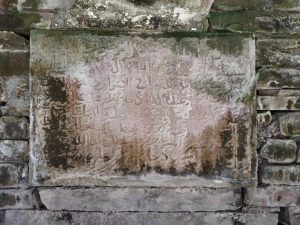
Arabic and Persian inscription (INAP00005) in a mosque (OBAP00005) near Chatua Darwaza recording the construction of the building by Khān-i ʿĀlam Jangi Khān in the time of Islām Shāh; working reading of the text 02/2020.
Udaypur उदयपुर (Madhya Pradesh). Mosque near Chatua Darwaza with an Arabic and Persian inscription (INAP00005)
Udaypur, उदयपुर (Madhya Pradesh).
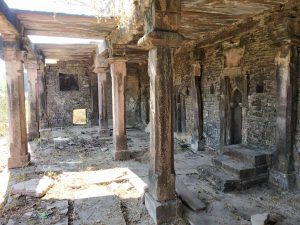
Mosque (OBAP00005) near Chatua Darwaza with an Arabic and Persian inscription (INAP00005) dated 1549 in the time of Islām Shāh of the Sūr dynasty.
IN01105 Inscription on a lapis intaglio (OB01105) with the bust of a woman.
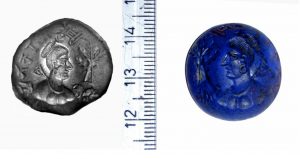
Intaglio in lapis (and modern impression) with the bust of a woman and an inscription.
OB01105 Intaglio in lapis with the bust of a woman and an inscription (IN01105).
Intaglio in lapis (and modern impression) with the bust of a woman and an inscription.
Votive inscription on a standing figure of Ambikā
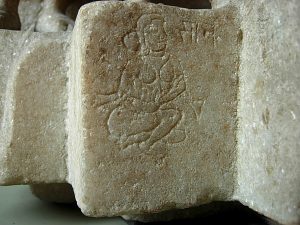
Votive inscription on a standing figure of Ambikā
Inscription of Bhoja on a standing figure of Ambikā
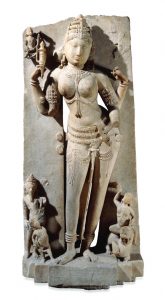
Standing figure of the Jaina goddess Ambikā from Dhār.