IN03196 Pālamōṭṭai Slab Inscription
This inscription is engraved on a stone slab, which was discovered by Senarath Paranavitana in 1933. Paranavitana found the slab among the ruins of a Śaiva kōvil at a place named Pālamōṭṭai near Kantaḷāy in the Trincomalee District of the Eastern Province. The architectural style of these ruins suggests that they date from the Poḷonnaruva period – a conclusion which is confirmed by the inscription. The inscription is badly weathered and some letters in the first four lines can only be read conjecturally. Due to the damaged condition of the record, it is difficult to decipher the name of the king in whose reign the record is dated. Senarath Paranavitana initially read the king’s name as Jayabāhu and the regnal year as the eighth (Archaeological Survey of Ceylon Annual Report for 1933, p. 14). However, after consulting with K. V. Subrahmanya Aiyer, Paranavitana revised his reading, taking the king’s name to be Vijayabāhu and the number of the regnal year, which is given in figures, to be forty-two (Epigraphia Zeylanica 4, pp. 192–193). If these readings are correct, the inscription can be assigned to the reign of Vijayabāhu I (r. 1056–1111), although this cannot be accepted with certainty.
The purpose of the inscription is to register donations to the god Śiva in the temple named Teṉ-Kailāsam (the Southern Kailāsam) at Kantaḷāy by a female Brahmin named Nāgaiccāṉi in memory of her husband. The inscription also records that the shrine had the name of Vijayarāja Īśvaram and that Kantḷāy was also called Vijayarāja Caturvedimaṅgalam. The appellation of the shrine suggests that it was founded by or under the patronage of Vijayabāhu I. The chronicles and other inscriptions represent this monarch as a great patron of Buddhism but clearly his zeal for Buddhism did not prevent him from extending his patronage to other faiths practiced by his subjects. The term ‘Caturvedimaṅgalam’ frequently features in South Indian inscriptions, where it is appended to the names of villages inhabited by Brahmins. As it was called Vijayarāja Caturvedimaṅgalam, Kantaḷāy must have had a colony of Brahmins who lived there under the protection of Vijayabāhu I. An inscription of king Niśśaṁka Malla found at the site (IN03105) indicates that Kantaḷāy kept its character as a seat of Brahmins for at least a century longer. In the present inscription, the charitable endowment is placed under the protection of the Veḷaikkāra regiment of Śrī Vikkirama Calāmega. As indicated by the Poḷonnaruva Slab Inscription of the Vēḷäikkāṟas (IN03103), the practice of placing a religious institution and its endowments under the protection of a regiment like the Veḷaikkāras was not unknown.
Pipaladā copper plate inscription of Bhoja dated VS 1077 and 1078
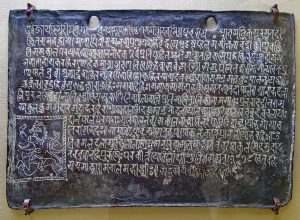
Pipaladā (Madhya Pradesh). Cooper plate charter of Bhoja dated VS 1077 and 1078
OB03154 Gonnǟva Dēvāle Fragmentary Pillar
IN03195 Gonnǟva Dēvāle Fragmentary Pillar Inscription
This fragmentary inscription is engraved on all four sides of the upper part of a stone pillar. The text originally continued on the lower part of the pillar, which is missing. Hence there are significant lacunae within the inscription. The surviving fragment of the pillar was first highlighted for scholarship in the Ceylon Journal of Science, Section G, vol. ii, p. 221. It is said to have been found in a land named Malhēna or Polgasyāya. In the 1930s, it was lying in the maṇḍapa of the modern dēvāle at Gonnǟva in the Dēvamädi Kōraḷē of the Kuruṇǟgala District (probably Gonnawa at 7.596588, 80.240385 or possibly Gonnawa at 7.518511, 80.107520), as Senarath Paranavitana recorded in the fourth volume of Epigraphia Zeylanica (p. 186). The inscription is dated in the eighth year of a king referred to by his throne name of Abhā Salamevan and contains a decree of the heir-apparent Udā (Udaya) granting immunities to a pamuṇu lank belong to a person named Agbo Mugayin Varadāṇa. The script used in the record belongs to the tenth century A.D. There are two Sinhalese kings of this period who, according to the order of succession, were entitled to the throne name (viruda) of Abhā Salamevan and who also had princes named Udaya as heirs-apparent. These were Dappula V (r. 940–952) and Sena III (r. 955–964), both of whom enjoyed reigns exceeding eight years in duration. It is not possible to say which of these two monarchs is the king mentioned in the present inscription. Since their reigns were only separated by three years, palaeography cannot be used to help settle the matter.
IN03194 Malagaṇē Pillar Inscription
This inscription is engraved on the four faces of a stone pillar, which Senarath Paranavitana reported in the 1930s to be lying within the premises of the Buddhist temple at Malagaṇē in the Girātalān Kōraḷē of the Kuruṇǟgala District. He also noted that the pillar been removed to this position some fifty years previously from Nuvarakälē, an extensive ancient site about three miles to the north-east of Malagaṇē, for use in the construction of a shrine, which had since been demolished. The inscription was first highlighted for scholarship in Archaeological Survey of Ceylon Annual Report for 1910–11 (Appendix F, p. 119, no. 105). It is dated in the tenth year of a king style Abhā Maharad but the identity of this monarch is uncertain. The inscription describes how Abhā Maharad brought Rohaṇa and Malaya under his dominion, achievements which are attributed – using almost exactly the same words – to king Udaya I (r. 901–912 A.D.) in the Tim̆biriväva pillar inscription (IN03067). Abhā Maharad may be a variation on Udǟ Abhā Salamevan and Udaya Abhaya, titles which are applied in other inscriptions to Udaya I. The king of the present inscription is also described as a relative of an earlier monarch named Abhā Sirisaṅgbo, a title which is applied to Sena II (r. 866–901) in the Ällēväva pillar inscription. This may support the identification of Abhā Maharad with Udaya I, since he was the younger brother and successor of Sena II. However, the word which expresses the exact nature of the relationship between Abhā Maharad and Abhā Sirisaṅgbo is unfortunately no longer legible and was interpreted as ‘son’ rather than ‘brother’ in an eye-copy of the inscription made under H. C. P. Bell’s direction for the Archaeological Survey in 1910–11. If this reading of the word is correct, the king in question could perhaps be Kassapa V (r. 929–939), both of who was a son of Sena II and used the viruda title of Abhā Salamevan, although he is not known to have subjugated Rohaṇa or Malaya. In terms of the palaeography, the inscription does feature some letter forms which appear to be slightly later in date than those used in known inscriptions of Udaya I. The text records immunities granted to a religious foundation called Saṅgradūn Pirivena in the monastery of Mirisipiṭi at Muhunnaru. This pirivena appears to have been named after Saṅghā, the queen of Sena II, who is referred to as Saṅgā-radū in the Pūjāvalī, and it is reasonable to assumed that Muhunnaru was the ancient name of the site where the pillar originally stood.
Pipaladā copper plate charter of Bhoja dated VS 1077 and VS 1078
Pipaladā (Indore Tahsil, Indore District, Madhya Pradesh). Copper plate charter of Bhoja. Indore, State Museum.
OB03152 Viyaulpata Pillar
IN03193 Viyaulpata Pillar Inscription
This inscription is engraved on the four faces of a rough stone pillar, which Senarath Paranavitana reported in the 1930s to be lying near the village called Viyaulpata (possibly Wayaulpota) in the Ināmaḷuva Kōraḷē of the Mātalē District. Since the stone of the pillar has not be dressed, its edges are not straight. The inscription runs vertically along the height of the pillar but, due to the uneven shape and rough surface of the pillar, the lines of the text are irregular and not of equal length. The record is dated in the first year of a king styled Sirisaṁboy and contains an edict issued by the heir-apparent (mahāpā) of the time, named Minhindal (Mahinda), granting certain immunities to a monastic dwelling called Sāṅguṇā-panhala. The viruda title ‘Sirisaṁbo’ or ‘Sirisaṁboy’ was borne by several kings of the ninth century, to which period this inscription has to be assigned on palaeographic grounds. The only Sirisaṁbo of this century whose mahāpā was called Mahinda was Sena II. Hence we can confidently assign the inscription to his reign, which began around 846 or possibly 866 and continued for thirty-four years. The inscribed pillar was set up and its edict proclaimed by two officers named Kaṇṇā (Kṛṣṇa) and Rāvaṇā, who are described as members of the body-guard, presumably meaning the mahāpā’s body-guard. These two officials, before setting up the pillar, are said to have assembled together the notables in the vicinity, probably from the monastic establishment mentioned in the inscription. This was doubtless done to give publicity to the royal order, so that the privileges granted by it might be respected by those concerned.